Medical Compression Garments vs Shapewear | Malaysia
Medical Compression Wear Is Not a Body Shaper — It Is a Support Device for Healing

Many people see a compression garment and immediately think of shapewear.
The confusion is understandable. Both are worn close to the body. Both can make the body look smoother. Both may feel tight when worn. But that is where the similarity largely ends.
Medical compression garments are designed to provide support during recovery — not simply to make the body look slimmer.
After procedures such as liposuction, tummy tuck, breast surgery, fat grafting, body contouring and other surgical procedures, the right post-surgical compression garment can form an important part of the recovery process. Think of it less like shapewear and more like a medical brace.
What Is a Medical Compression Garment?
A medical compression garment is a specially designed garment that applies controlled, supportive pressure to specific areas of the body.
Unlike ordinary shapewear, medical compression wear is designed around factors such as:
The type of surgery performed
The area being treated
Post-operative swelling
Body measurements
The level and distribution of compression required
The need for support during movement and recovery
The patient's comfort and ability to wear the garment correctly
This is why choosing a medical compression garment after surgery should not simply be a matter of buying the same clothing size that you normally wear.
The garment has a medical purpose.
We Understand Braces — So Why Do We Think Compression Is Shapewear?
Consider a knee brace.
If someone injures their knee, a doctor may recommend a knee brace to provide support and stability.
Nobody normally asks:
"Why are you wearing that? Is it supposed to make your knee look smaller?"
The purpose is understood. The brace is there to support the body while it recovers.
The same principle applies to a wrist support or arm brace following an injury or procedure.
Dental braces provide another familiar comparison. They apply controlled forces over time to guide teeth into their intended position.
Medical compression wear works on the same basic concept of controlled support.
It is not simply clothing. It is designed to perform a specific function.
Compression After Surgery Is About Healing — Not Body Shaping
Following surgery, the body goes through a natural healing process. Depending on the procedure, patients may experience swelling, fluid changes, tenderness and changes in the shape and condition of the treated tissues.
This is particularly relevant following procedures such as:
Liposuction
Tummy tuck
Fat grafting
Brazilian Butt Lift (BBL)
Thigh and arm liposuction
Breast surgery
Breast augmentation
Breast reduction
Breast reconstruction
Gynecomastia surgery
Body contouring
Other plastic and reconstructive procedures
A properly selected post-operative compression garment can provide support to the treated areas during recovery.
Depending on the garment and procedure, compression may help with:
Supporting healing tissues
Managing post-operative swelling
Providing support to treated areas
Improving comfort during movement
Helping the treated area feel more secure during recovery
The objective is not simply to "squeeze the patient smaller."
The objective is appropriate support during the healing period.
Patients should, of course, follow their surgeon's specific instructions regarding whether compression is appropriate, which garment to use and how long it should be worn.
Medical Compression Garments Are Not the Same as Shapewear
One of the biggest misconceptions is that a medical compression garment is simply a more expensive or tighter version of ordinary shapewear. It isn't.
Shapewear
Shapewear is primarily designed for appearance.
It may:
Smooth the body's contours
Create a temporary slimming effect
Improve the appearance of clothing
Change the visible silhouette
Medical Compression Wear
Medical compression garments are designed for a specific supportive purpose.
They may incorporate:
Targeted compression panels
Different levels of compression
Stronger support zones
Surgical openings
Open-crotch designs
Anatomically positioned panels
Powernet or other specialised fabrics
Specific garment construction for different procedures
The garment is therefore selected according to the procedure and the patient's measurements, rather than simply according to fashion preferences.
"I Normally Wear Medium — Why Do I Need a Different Size?"
This is one of the most common questions surrounding post-surgical compression garments.
The answer is simple:
Clothing size and medical garment sizing are not necessarily the same thing.
A patient may normally wear a Medium shirt or trousers but require a different size in a medical compression garment.
Why?
Because medical compression garments are fitted according to measurements and the intended compression and support.
The garment may also need to accommodate the specific area that has undergone surgery.
This is why medical compression garment measurement is important.
Choosing a garment by looking at the label alone can be misleading.
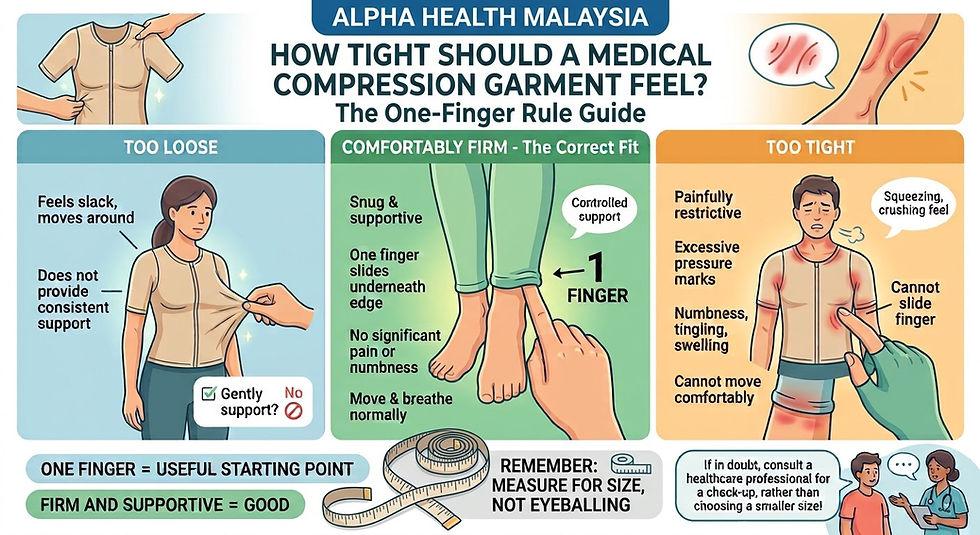
A Compression Garment Should Not Simply Be "As Tight As Possible"
Another common misconception is that tighter automatically means better.
It doesn't.
Medical compression needs to be appropriate for the intended purpose and the patient's circumstances.
A garment that is excessively tight may be uncomfortable and difficult to wear correctly.
A garment that is too loose may not provide the intended level of support.
The goal is therefore not maximum tightness.
The goal is appropriate compression.
This is one reason professional guidance and accurate measurements matter when selecting post-surgical compression wear.
Why Surgical Compression Garments Can Feel Different From Normal Clothing
Patients sometimes expect a medical compression garment to feel like ordinary underwear or comfortable sportswear. That expectation can lead to disappointment.
A garment designed to provide meaningful compression may feel:
Firmer
Tighter
More structured
Less flexible
Less "comfortable" initially than ordinary clothing
This does not automatically mean something is wrong with the garment.
Medical compression is functional.
In simple terms, it is a little like comparing a soft casual shoe with a supportive medical brace. They are designed for different purposes.
Medical compression does not have to be fashionable to be functional.
The Difference Is in the Design
A good post-surgical compression garment is not simply a piece of tight fabric.
Its construction can be designed around the requirements of the procedure.
For example, garments may incorporate different compression zones or targeted panels depending on the area being treated.
Some procedures may require compression around the abdomen. Others may require support around the thighs, arms, back, waist or breast area. Some garments also have practical features such as an open crotch or adjustable fastenings to make them easier to use during recovery.
This is why the right garment should be considered according to procedure, anatomy and measurements, rather than appearance alone.
Medical Compression Is a Support Tool — Not a Slimming Solution
It is important to make another distinction.
A medical compression garment is not intended to be a weight-loss product.
It may temporarily make the body appear more streamlined while it is being worn, but that is not its primary medical purpose. Patients should not confuse: compression for recovery
with compression for slimming. They are two very different concepts.
Think of Medical Compression Like a Brace
The easiest way to understand medical compression wear is to think about the other support devices we already accept.
A knee brace supports a knee.
A wrist brace supports a wrist.
An ankle support supports an ankle.
Dental braces apply controlled forces to teeth.
A medical compression garment provides controlled compression and support to selected areas of the body.
It is not primarily about changing how the body looks. It is about supporting the body while it recovers.
Choosing the Right Post-Surgical Compression Garment
If you are looking for a compression garment after surgery, do not start with the question:
"Which one looks the best?"
Start with:
"What procedure was performed, and what type of support is required?"
Then consider:
The procedure — Liposuction, tummy tuck, breast surgery, fat grafting and other procedures may require different garment designs.
The treatment area — The garment should provide appropriate coverage and support for the area being treated.
Your measurements — Medical compression garments should be selected using the manufacturer's measurement guidelines.
Compression requirements — More compression is not automatically better.
Garment construction — Features such as targeted panels, fastenings and openings can affect practicality and comfort.
Your surgeon's instructions — Your surgeon should determine whether compression is appropriate for your particular recovery.
Medical Compression Garments in Malaysia
In Malaysia, patients can encounter many products described as compression wear, slimming wear, shapewear or body shapers.
The terminology can be confusing.
For patients recovering from surgery, the important question is not simply whether a garment is "tight."
The important question is whether it is designed and selected for the intended post-surgical application.
This is where specialist product knowledge matters.
Alpha Health Malaysia — Medical Compression Expertise
For more than 20 years, Alpha Health Malaysia has been supplying medical and post-surgical compression solutions in Malaysia.
We work with healthcare professionals and patients across procedures including body contouring, liposuction, tummy tuck, breast surgery, fat grafting and other post-surgical applications.
Alpha Health represents specialized compression garment brands including Design Veronique and MAAM, providing access to purpose-designed compression solutions rather than treating medical compression as ordinary shapewear.
Our role is not simply to sell a garment.
It is to help healthcare professionals and patients understand the difference between medical compression, ordinary shapewear and body-shaping clothing, and to select a garment according to the procedure, measurements and intended use.
Because medical compression is not about making the body look smaller.
It is about providing the right support when the body needs it most.
Looking for Medical Compression Garments in Malaysia?
Talk to Alpha Health Malaysia about post-surgical compression garments for plastic surgery, breast surgery, liposuction, tummy tuck, fat grafting, body contouring and other recovery applications.
WhatsApp: 011 1286 8768 / 019 227 3684
or visit us at:
Medical compression garments should be used according to the advice of your surgeon, healthcare professional or the garment experts at Alpha Health Malaysia


Comments