When to Wear a Post-Surgical Compression Garment | Alpha Health Malaysia

Don't Save Your Post-Surgical Compression Garment for Later
When should you start wearing a compression garment after surgery?
One of the most common misconceptions about post-surgical compression garments is that you should wait until swelling has gone down before wearing one.
After more than 20 years of supplying medical compression garments in Malaysia, we've heard this question many times. And interestingly, the thinking isn't limited to patients.
Sometimes doctors, nurses and clinic staff ask the same question:
"If the swelling is going to reduce anyway, wouldn't it make sense to wait before buying a compression garment? Otherwise, I may need a smaller size later."
At first, that sounds logical.
But it misunderstands the purpose of a post-operative compression garment.
A compression garment isn't simply something you wear because you are already swollen.
It is prescribed or recommended as part of post-surgical care to provide controlled compression and support during the recovery process.
That's why when you wear it can matter just as much as what garment you choose.
What Is a Post-Surgical Compression Garment?
A post-surgical compression garment is specially designed to provide controlled pressure and support to areas of the body following certain surgical procedures.
Unlike ordinary slimming garments, shapewear or yoga clothing, medical compression garments are designed around the needs of recovery.
Depending on the procedure, they may be used after:
Liposuction
Tummy tuck (abdominoplasty)
Breast surgery
Breast augmentation or breast reduction
Gynecomastia surgery
Fat grafting and body contouring
Brazilian Butt Lift (BBL)
Arm or thigh liposuction
Bariatric surgery
Certain facial procedures
Other plastic, reconstructive or body-contouring procedures
The exact garment, compression level, design and duration of wear should always follow the operating surgeon's instructions.
Why Wear a Compression Garment After Surgery?
Surgery causes controlled tissue injury. As part of the body's normal healing response, inflammation and fluid accumulation can occur around the operated area.
A properly selected compression garment can provide controlled external pressure and support during this period.
Depending on the procedure and the surgeon's protocol, compression may help with:
Managing post-operative swelling
Supporting healing tissues
Providing physical support to treated areas
Improving comfort and mobility
Helping patients feel more secure during movement
Maintaining compression over the treated area
The important point is that compression is generally used as part of the recovery process, rather than being something to introduce only after swelling has already disappeared.
When Should You Start Wearing a Compression Garment After Surgery?
There is no single starting time that applies to every operation.
The correct timing depends on the procedure, surgical technique, wound condition and your surgeon's post-operative protocol.
For many plastic and body-contouring procedures, however, the compression garment is intended to be used early in the recovery period, according to the surgeon's instructions.
That is why it is usually better to have the appropriate garment prepared before surgery, rather than waiting until swelling has already developed.
Your surgeon may instruct you to wear it immediately after surgery, after dressings are removed, or at another specific stage.
Follow your surgeon's instructions rather than assuming that every procedure requires the same compression schedule.
"But Won't I Need a Smaller Size Later?"
Possibly.
And that isn't necessarily a problem. Your body changes during recovery. As swelling reduces and tissues settle, your measurements can change. A garment that is appropriate during the early post-operative period may eventually feel looser.
That does not mean the original garment was incorrectly selected.
It means your body is changing.
Think of the garment as a recovery tool, rather than ordinary clothing that you are buying for long-term use.
The objective isn't necessarily to make one garment last for as many months as possible.
The objective is to have the appropriate compression and fit for the stage of recovery you are in.
In some cases, your surgeon or garment supplier may recommend changing to another size or design as your body changes.
Why Waiting for the Swelling to Go Down Can Be Misleading
The reasoning often goes like this:
"I'm swollen now, so I'll wait until the swelling decreases before buying my garment."
The problem is that this treats the compression garment as though its only purpose is to make existing swelling disappear.
That's not how post-surgical compression should be viewed.
The garment forms part of the recovery process from the beginning. Waiting until your body has already changed significantly can also create practical problems. The garment may become more difficult to fit correctly, and you may spend valuable recovery time without the support your surgeon intended you to have.
It's a little like bringing an umbrella after you've already been caught in the rain.
The umbrella may still be useful for the next shower. But it couldn't prevent you from getting wet in the first place.
A Compression Garment Is Not a Slimming Girdle
This is another important distinction.
Many patients see a compression garment and think:
"It looks like shapewear."
But appearance can be misleading.
A post-surgical compression garment is not simply a slimming garment or body shaper.
Ordinary shapewear is generally designed to change the appearance of the body while it is being worn.
A post-surgical garment is selected for a medical recovery purpose, with considerations such as:
The surgical area
Compression requirements
Garment construction
Fabric characteristics
Targeted compression panels
Fit and measurements
Ease of putting on and removing the garment
Open-crotch or other functional designs where appropriate
This is why choosing a garment based purely on how it looks, or buying a smaller size because you think tighter is better, can be a mistake.
Post-surgical compression should be fitted for its intended medical purpose—not simply for maximum tightness.
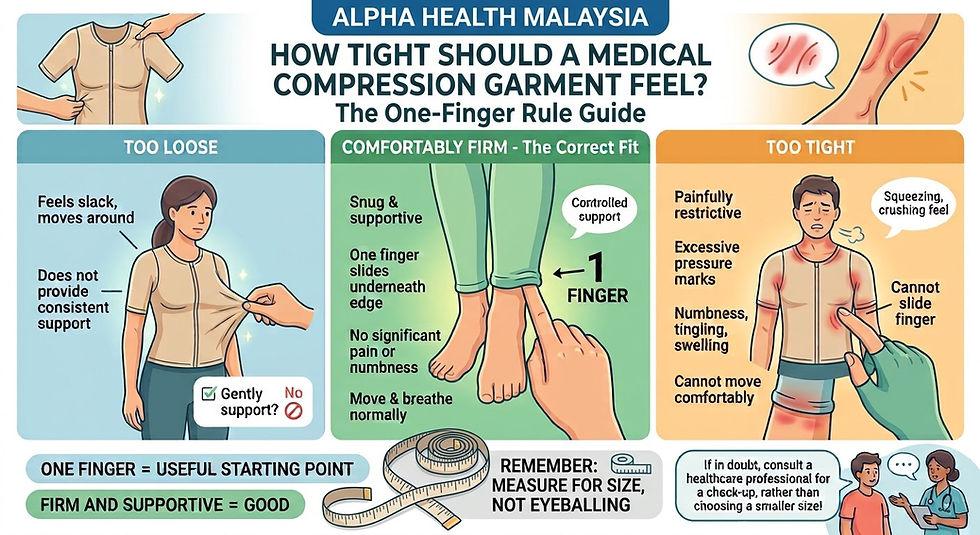
Why the Correct Fit Matters
A compression garment should provide appropriate, controlled compression without creating unnecessary problems.
Too loose, and it may not provide the intended support.
Too tight, and it may become uncomfortable, difficult to wear, or inappropriate for the recovering area.
This is why measuring matters.
At Alpha Health Malaysia, one of the most common misconceptions we encounter is that patients can simply look at a garment and decide which size they need.
Post-surgical garments should be selected according to measurements, the procedure performed and the garment design, rather than visual guesswork.
And remember:
XL is a manufacturer's size code—not a universal measurement. An XL in one garment is not necessarily the same as an XL in another.
The First Garment May Not Be Your Last
Recovery is not static.
Your body can change substantially during the first few weeks following surgery. For some patients, this means progressing from one garment size to another. For others, the same garment may remain appropriate for the recommended period. There is no universal rule.
The important thing is to select the garment according to your current measurements and your surgeon's instructions, rather than trying to predict exactly what your body will look like several weeks later.
What About Liposuction and Body Contouring?
Compression garments are particularly commonly associated with procedures such as:
Liposuction
Tummy tuck
Arm liposuction
Thigh liposuction
BBL and fat-transfer procedures
Multiple-area body contouring
These procedures can involve significant changes to the soft tissues and can produce post-operative swelling.
The garment therefore needs to be appropriate for the specific areas treated.
A garment suitable for abdominal liposuction may not be appropriate for a patient who has undergone breast surgery, for example.
This is why there is no single "best compression garment" for every operation.
The best garment is the one appropriate for the procedure, treatment area, measurements and surgeon's recovery protocol.
Don't Buy a Smaller Garment Just Because You Want More Compression
One of the most common mistakes is assuming:
Tighter = better.
It doesn't.
A compression garment is not supposed to be selected simply by choosing the smallest size you can tolerate.
The garment needs to provide the intended compression while remaining suitable for the recovering tissues and practical enough for the patient to wear as instructed.
If a garment is extremely difficult to put on, causes significant discomfort, creates pressure in the wrong area or cannot be worn as directed, it may not be serving its intended purpose.
If you are unsure about fit, speak to your surgeon, clinic or an experienced medical compression garment supplier.
Don't Think of It as Clothing. Think of It as Part of Recovery.
This is perhaps the most important change in mindset. We normally judge clothing by how long it lasts. A good shirt can be worn for years. A good pair of trousers can last for seasons.
But a post-surgical compression garment is different.
Its value is not determined simply by how long you own it. Its value comes from how appropriately it performs its intended function during recovery.
That is why delaying the purchase or use of a compression garment simply because you are worried about needing another size later may not make sense.
You are trying to maximise the lifespan of the garment when the real objective is to support the recovery process.
Think About an Expensive Wound Dressing
Consider another medical product.
An advanced post-operative wound dressing may be expensive.
But you wouldn't normally delay using it simply to make the dressing last longer.
Its value comes from being used when it is clinically indicated.
The same principle applies to post-surgical compression.
The question isn't:
"How long can I make this garment last?"
The more useful question is:
"Is this the appropriate garment for the stage of recovery I am in?"
That is a much better way to think about medical compression.
So, When Should You Buy Your Compression Garment?
If your surgeon has recommended a post-surgical compression garment, it is generally sensible to arrange the appropriate garment before your surgery, rather than waiting until after the procedure to start looking for one.
This gives you time to:
Take the correct measurements.
Identify the appropriate garment design.
Confirm the required size.
Understand how to put it on and remove it.
Follow your surgeon's instructions from the appropriate stage of recovery.
Your surgeon's instructions should always take priority because different operations and patients require different approaches.
Frequently Asked Questions About Post-Surgical Compression Garments
How soon after surgery should I wear a compression garment?
It depends on the procedure and your surgeon's instructions. Some patients are instructed to wear compression immediately or very soon after surgery, while others may have a different schedule.
Should I wait for swelling to go down before buying a compression garment?
Usually, it is better to prepare the recommended garment before surgery rather than wait for swelling to disappear. Your surgeon or garment specialist can advise on the appropriate size and design for your procedure.
Will I need a smaller compression garment later?
Possibly. As swelling reduces and your body changes during recovery, your measurements may change. Some patients therefore progress to another size or garment.
Is a compression garment the same as shapewear?
No. Post-surgical compression garments are designed for recovery following specific procedures, while ordinary shapewear is primarily designed to alter body appearance.
Does tighter compression mean better results?
Not necessarily. The garment should provide appropriate compression and fit for the intended purpose. Excessive tightness is not automatically better.
Can I use the same compression garment after every type of surgery?
No. Different procedures require different garment designs and coverage. A garment for abdominal liposuction may be very different from one used after breast surgery or facial procedures.
The Bottom Line
If your surgeon recommends a post-surgical compression garment, don't think of it as something you buy only after the swelling has gone down.
The garment is part of the recovery process.
Have it ready.
Get the correct measurements.
Choose the appropriate design for your procedure. And use it according to your surgeon's instructions. You may eventually need another size as your body changes. That's okay.
It doesn't mean the first garment was wasted. It means your body is recovering.
Don't save your compression garment for later just because you want to make it last longer.
Medical products are not necessarily most valuable because they are used for the longest time.
They are valuable when they are used appropriately, for the purpose they were designed for, at the stage when they are needed.
When it comes to post-surgical recovery, timing, fit and appropriate compression matter.
About Alpha Health Malaysia
For more than 20 years, Alpha Health Malaysia has supplied post-surgical and medical compression garments to healthcare professionals and patients in Malaysia.
We represent specialized compression garment brands including Design Veronique and MAAM, serving patients undergoing plastic, reconstructive, cosmetic and other surgical procedures.
Our role is not simply to sell a garment.
We help healthcare professionals and patients identify the appropriate garment design, coverage and size for the intended procedure, based on measurements and clinical requirements.
For advice on post-surgical compression garments in Malaysia, contact Alpha Health Malaysia. https://www.ahmalaysia.com/post-surgical-compression-garments


Comments