Why Tighter Is NOT Better: The Right Medical Compression After Liposuction
- canyup
- 2 days ago
- 4 min read
More Compression Does Not Mean Better Healing After Liposuction

After liposuction, many patients are eager to do everything possible to achieve the best recovery. One of the most common beliefs we hear is:
“If compression is good for healing, then tighter compression must be even better.”
It sounds logical—but it is not quite how medical compression works.
A compression garment is not supposed to squeeze your body as tightly as possible. It is designed to provide the appropriate level of support and compression for your body and your stage of recovery.
Think About Vitamin C
Here is a simple example. Vitamin C is an important supplement and is beneficial to the body. But taking more and more Vitamin C does not mean you will get more and more benefits. Too much can cause unwanted side effects.
Compression follows a similar principle.
The right amount of compression can provide useful support during recovery. But more compression does not automatically mean more healing.
The goal is not to find the tightest garment you can tolerate. The goal is to find the right compression for your recovery.
Medical Compression Is Not Body Shaping
This is where a lot of confusion comes from.
Patients may be familiar with body shapers, shaping girdles or sportswear. These garments can fit tightly around the body, so it is understandable that people assume they are essentially the same thing as medical compression garments. They are not.
A body shaper is primarily designed to shape or smooth the body's appearance.
Sportswear is designed for movement, comfort and performance during physical activity. A shaping girdle is generally designed to provide support or create a particular silhouette.
A medical compression garment is different because its design is based on delivering controlled compression for a medical purpose. It is not simply about making the garment tighter.
Compression Where It Is Needed
One of the important differences with medical compression garments is that the garment is designed to provide the appropriate amount of compression to the appropriate areas.
The pressure is not necessarily intended to be identical everywhere. Different parts of the garment can be designed to provide different levels of support or compression, depending on the purpose of the garment and the area being treated. This is why a medical compression garment is more than simply a piece of tight clothing. It is designed around the patient's body, the surgical area and the intended medical function.
It is not “more compression everywhere.” It is the right compression in the right places.
Think of It Like a Bandage
A simple way to understand this is to think about a wound bandage. A bandage has a purpose. You use enough support to protect and manage the wound—but you would not keep wrapping it tighter and tighter simply because you believe more pressure must be better. A compression garment works on the same basic principle. It is there to provide appropriate medical support during recovery.
The objective is controlled compression—not maximum compression.
Your Body Is Not a Standard Size
Another reason not to simply choose the smallest garment possible is that every patient's body is different. Two people may have the same weight but completely different body measurements and proportions. After surgery, the treated areas may also have different levels of swelling.
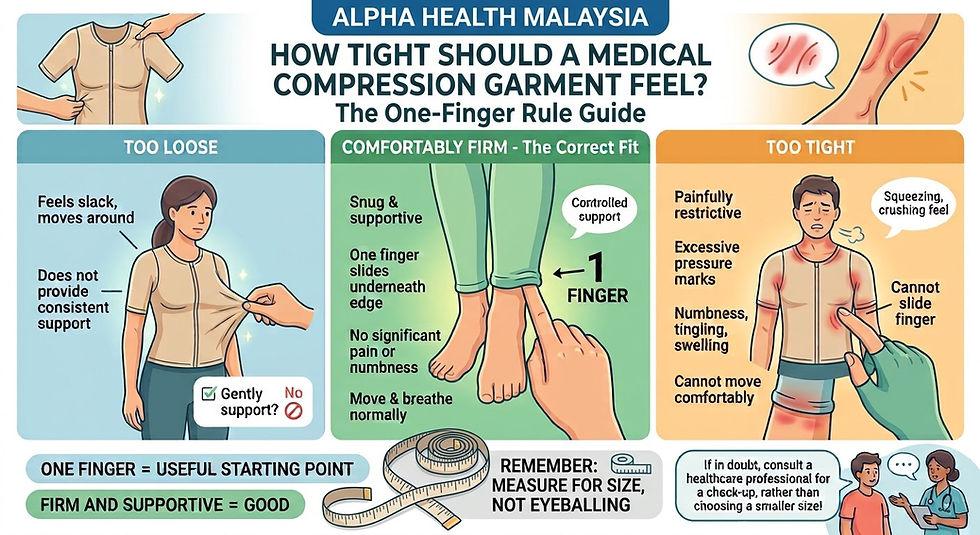
A medical compression garment should be selected based on actual measurements, the area treated, the garment design and the surgeon's postoperative instructions—not simply because the patient believes a smaller size must work better.
“Tighter” Is Not the Same as “Better”
There is a big difference between a garment being snug and supportive and being uncomfortably tight. A properly fitted garment should provide the intended compression without making you feel that you are being squeezed into it. If the garment causes significant discomfort, numbness, unusual pressure, skin problems or difficulty breathing or moving, do not simply assume that this means it is “working harder.”
Speak to your surgeon or the professional who fitted the garment.
The Right Compression Matters
Just as with many things in medicine, there is a balance. Too little may not provide the intended support. Too much is not necessarily better. The objective is to find the right level of compression for the individual patient. So after liposuction, remember:
More compression does not mean better healing.
The smallest garment is not necessarily the best garment.
The tightest garment is not necessarily the most effective garment.
Medical compression is about the right garment, the right fit, the right amount of compression and the right areas of compression.
Your compression garment should be properly fitted and worn according to your surgeon's instructions. Because when it comes to medical compression, the goal is not to make you feel as tightly squeezed as possible.
The goal is to provide the right medical support, in the right places, while your body heals.
Alpha Health Malaysia — Experience Matters
At Alpha Health Malaysia, we have been supplying medical compression garments for approximately 40 years, helping patients and healthcare professionals select garments designed specifically for postoperative recovery. Our experience has taught us one important lesson:
A medical compression garment is not simply a tight garment.
It is a carefully designed medical support garment where fit, construction, compression and placement all matter.
The objective is never to make the patient wear the tightest garment possible.
It is to provide the right compression, in the right places, for the right purpose.


Comments